

Most small business owners know blogging helps SEO, but few agree on how often to publish. The honest answer depends on your team size, your industry, and what you can sustain without sacrificing quality.
This guide breaks down research-backed publishing frequencies, explains what each cadence actually delivers, and helps you choose a realistic schedule that builds organic traffic over time.
Key Takeaways
- Sustainable blogging for small businesses starts at 1-2 high-quality posts per month, not daily publishing marathons.
- New blogs under one year old benefit from accelerated cadences of 6-8 posts monthly to establish topical authority faster.
- Websites publishing 9 or more posts per month achieved 3.6 times the organic traffic growth of sites publishing 1-4 posts monthly in a 2025 B2B SaaS SEO study.
- Consistency matters more than frequency: a sporadic burst of posts followed by months of silence signals neglect to both readers and search engines.
Why Publishing Frequency Matters for SEO
Search engines use crawl frequency and content freshness as signals of site health and relevance. When Googlebot discovers new content on a predictable schedule, it learns to return more often, which can accelerate indexing of future posts.
For small businesses competing in local or niche markets, a steady publishing rhythm also builds topical authority. Each post is an opportunity to target long-tail keywords, answer specific customer questions, and earn internal linking opportunities that strengthen your site architecture.
Blog Publishing Frequency Benchmarks
All benchmarks derived from 2025 B2B SaaS SEO research published by Stratabeat.

The Sustainable Baseline: One to Two Posts Per Month
Small businesses and solo founders can use one or two excellent posts per month as a legitimate, sustainable SEO cadence. This pace requires roughly 4-8 hours of focused work per post, which is realistic for owners who handle their own marketing.
The key at this frequency is depth over breadth. A single 2,000-word guide that thoroughly answers a customer question will outperform four thin 400-word posts that barely scratch the surface.
Search engines reward comprehensive content that satisfies user intent.
The Common Small-Business Range: Two to Four Posts Per Month
Publishing two to four posts per month can help maintain crawl freshness and topical signals while remaining practical for many small businesses. This cadence typically requires either a dedicated marketing team member or a reliable freelance relationship.
At this frequency, businesses can begin building topic clusters: a pillar page supported by related subtopic posts that link back to it. This structure helps search engines understand your site’s thematic focus and can improve rankings across an entire keyword group.

Weekly Publishing and When It Makes Sense
One well-written article per week is often sufficient for a local service business, specialist consultancy, or growinge-commerce brand. This pace demands roughly 8-12 hours of content production weekly, including research, writing, editing, and promotion.
Weekly publishing works best when you have a documented content strategy with pre-planned topics, an editorial calendar, and established workflows. Without these systems, the seventh week of a weekly schedule often produces rushed, lower-quality content that undermines earlier gains.
Accelerated Cadences for New Blogs Under One Year
Blogs less than one year old may target six to eight posts per month focused on a few important topic clusters. Young domains lack the backlink profile and historical trust that older sites enjoy, so they need to demonstrate expertise and activity more aggressively.
This accelerated pace is temporary, not permanent. Once a new blog has 30-50 substantial posts covering its core topics, it can scale back to a sustainable maintenance cadence without losing momentum.
The goal is to reach critical mass of indexed, interlinked content.
High-Frequency Publishing and the Traffic Multiplier Effect
In a 2025 B2B SaaS SEO study, websites publishing nine or more posts per month achieved 3.6 times the organic-traffic growth of sites publishing one to four posts monthly. Stratabeat (2025)
The top 10% of websites in that same study averaged 11 blog posts per month. Stratabeat (2025) However, these figures come from well-resourced marketing operations with dedicated content teams, editorial workflows, and promotion budgets.
How The SEO IT Guy Approaches Content Cadence for MSPs
The SEO IT Guy works exclusively with IT companies and managed IT services providers, which means we understand the operational realities that limit your publishing bandwidth. Most MSP owners we speak with cannot sustain daily or even weekly blogging alongside running their technical operations.
Our approach starts with a consulting conversation about your goals, your available time, and your competitive landscape in your local market. We then build a customized content roadmap that targets the primary keywords, service pages, and topic clusters that actually drive leads for IT businesses.
Clients receive everything for one fixed monthly rate without needing to hand-hold the process.
Matching Cadence to Your Buyer’s Journey Length
MSPs serve clients who rarely impulse-buy. A typical prospect researches for sixty to ninety days before signing a managed services agreement.
Your blog cadence should cover that entire window without gaps. Publishing only at the top of the funnel leaves prospects hungry for mid-funnel proof when they are ready to evaluate vendors.
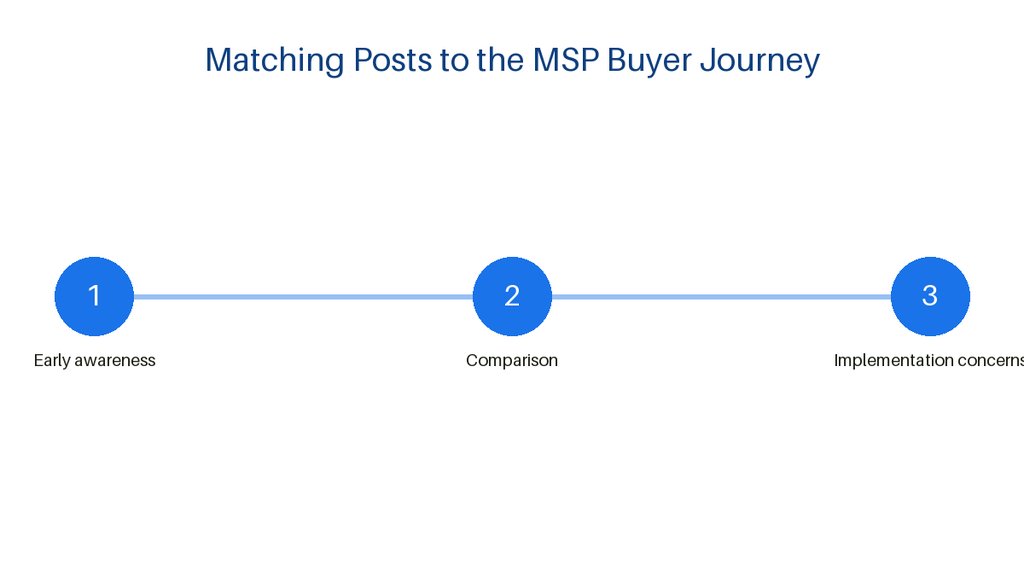
Map each month’s posts to a specific journey stage. One piece might address early awareness, while another handles comparison or implementation concerns.
This staged approach lets you maintain a modest schedule while still appearing everywhere your prospect looks. Frequency becomes less about volume and more about strategic coverage.
Review your sales team’s data to learn the real timeline. If average close cycles stretch six months, your content calendar must sustain relevance across that same stretch.
Shorten or lengthen individual posts based on stage needs. Early awareness pieces can be brief and frequent; deep evaluation content naturally takes longer to produce and can space out accordingly.
The goal is uninterrupted presence, not exhaustion. A prospect who finds your March article and returns in June should discover fresh, relevant material waiting.
The Hidden Cost of Inconsistent Publishing Bursts
Many MSPs blog heavily for one quarter, then vanish for two. This boom-and-bust pattern confuses both readers and search algorithms.
Google’s crawlers learn your rhythm. When fresh content appears predictably, they visit more often and index faster.
Erratic schedules trigger the opposite behavior.
Your audience notices too. A prospect who subscribes during your active period receives silence afterward, training them to ignore future messages when you resume.
The recovery period after a drought often exceeds the drought itself. Rebuilding crawl frequency, subscriber engagement, and topical authority takes sustained effort that could have been avoided.
Plan your cadence around what you can sustain through vacations, quarter-end rushes, and staffing changes. Better to under-promise and over-deliver than the reverse.
Build a small content reserve during lighter sales periods. Having two or three completed pieces ready for slow production months protects your consistency without requiring heroic effort.
Track publication dates in a simple spreadsheet. Visualizing your actual pattern, not your intended one, reveals whether your cadence is genuinely steady or merely aspirational.
Repurposing as a Cadence Multiplier for Resource-Constrained Teams
A single well-researched post can fuel an entire month of touchpoints without repeating yourself verbatim. This multiplier effect stretches limited MSP marketing resources considerably.
Start with a comprehensive cornerstone piece, perhaps two thousand words on cloud migration security. From that foundation, extract a checklist, a LinkedIn carousel, an email snippet, and a FAQ update.
Each derivative asset reinforces the original SEO value while serving different consumption preferences. Some prospects read long-form; others scan checklists or watch summaries.
This approach also solves the blank-page problem that stalls many technical founders. Once the core research exists, creating variations feels less daunting than starting from zero each week.
Schedule the original post and its derivatives across several weeks rather than dumping them simultaneously. Staggered release maintains presence while multiplying the return on your creation effort.
Measure which formats resonate with your specific audience. Over time, you will learn whether your prospects prefer expanded articles, condensed visuals, or audio adaptations, letting you prioritize accordingly.
Repurposing does not mean lazy recycling. Each version must stand alone with genuine utility.
Done well, it amplifies cadence without multiplying workload or sacrificing quality.

Frequently Asked Questions
How often should a business blog to see SEO results?
Most small businesses see measurable SEO improvements with 1-2 high-quality posts per month sustained over 6-12 months. New blogs may accelerate to 6-8 posts monthly initially to build topical authority faster, then settle into a maintenance cadence.
Is it better to publish more posts or better posts?
Better posts almost always win. One comprehensive, well-researched article that thoroughly answers user intent will outperform several thin posts.
Search engines prioritize content satisfaction signals like dwell time and low bounce rates over raw post volume.
What happens if I stop blogging for a few months?
Existing posts continue to attract traffic, but growth typically stalls without fresh content signaling site activity to search engines. When you resume, expect a 4-8 week lag before crawl frequency and rankings respond to the renewed publishing rhythm.
Can a small MSP really compete with larger competitors that publish daily?
Yes, by focusing on niche expertise and local market knowledge that generic content cannot replicate. A weekly or biweekly post about specific IT challenges in your city, written with insider technical accuracy, often outranks generic daily content from national publishers.
How does The SEO IT Guy help with content planning and execution?
We handle keyword research, topic strategy, content creation, and optimization as part of our fixed monthly SEO services for MSPs. Our team understands the technical language your prospects use, so we produce content that ranks and converts without requiring your direct involvement in every draft.
Should I adjust my blogging frequency based on seasonality in the MSP industry?
Yes, modest adjustments make sense. Many MSPs see budget conversations peak in Q4 and decision-making accelerate in Q1.
Increasing cadence six to eight weeks before these peaks keeps your expertise visible when prospects research. Conversely, reducing slightly during deep summer lulls avoids wasted effort, provided you maintain baseline consistency rather than disappearing entirely.
The key is planning these shifts in advance rather than reacting month to month.

About the author
Steve Dempsey - Owner / Founder
Steve Dempsey is the owner and founder of The SEO IT Guy, an SEO agency for managed IT services providers that he started after more than 20 years running his own IT support company.