

AI detectors promise to flag machine-written content, but the numbers behind them tell a more complicated story. Before you use one to screen job applications, audit vendor proposals, or check customer communications, you need to understand what these tools actually get right and where they fail.
Small business owners already juggle enough without adding unreliable automation to their workflows. This guide breaks down the research on AI detector accuracy, explains who gets hurt most by false positives, and shows how to protect your business from bad data-driven decisions.
Key Takeaways
- AI detectors misclassified a majority of non-native English writing samples as AI-generated in controlled testing.
- Commercially available detection tools correctly identified AI content roughly 63% of the time in one institutional study.
- All seven detectors tested unanimously flagged nearly 20% of non-native English essays as AI-generated.
- Human oversight and documented review policies reduce the risk of unfair outcomes from automated screening tools.
How AI detectors actually work
AI detectors analyze text patterns like perplexity, burstiness, and token probability to guess whether a human or a machine wrote the content. These tools train on large datasets of known human and AI writing, then apply statistical models to score new text.
No detector reads meaning or intent. It measures mathematical similarity to patterns in its training data, which creates blind spots for writing styles that differ from the majority of its examples.
AI Detector Accuracy: Key Research Findings
Some figures from Illinois State source are from a webpage with 2026 metadata.
What the research says about accuracy rates
A study of commercially available AI detectors found they correctly identified AI-generated content approximately Illinois State University (2026) of the time. That same study reported false-positive rates between 24.5% and 25%, meaning roughly one in four human-written samples got incorrectly flagged.
Approximately 37% of AI-generated samples were missed in that study, showing these tools struggle with both false positives and false negatives. Some figures from the Illinois State source are from a webpage with 2026 metadata.
Who gets hurt most by false positives
Non-native English writers face dramatically higher false accusation rates. In a peer-reviewed evaluation, seven publicly available GPT detectors incorrectly classified approximately Patterns (2023) of non-native English writing samples as AI-generated.
All seven detectors unanimously identified 18 of 91 non-native English essays as AI-generated, representing 19.8% of samples. At least one of the seven detectors flagged 89 of 91 TOEFL essays as AI-generated.
These patterns raise serious fairness concerns for any business using detectors to screen international candidates, vendors, or partners.
Real business risks of trusting detector scores
Small businesses that rely on AI detectors for hiring, contract review, or customer communication screening can make costly mistakes without realizing it. A rejected job candidate, a dismissed vendor proposal, or an escalated customer dispute based on a false positive wastes time and damages relationships.
Using detector scores as a primary decision factor without secondary review creates operational risk. The tools are marketed as objective, but their error rates mean they function more like a rough filter than a definitive test.
Smarter ways to evaluate content authenticity
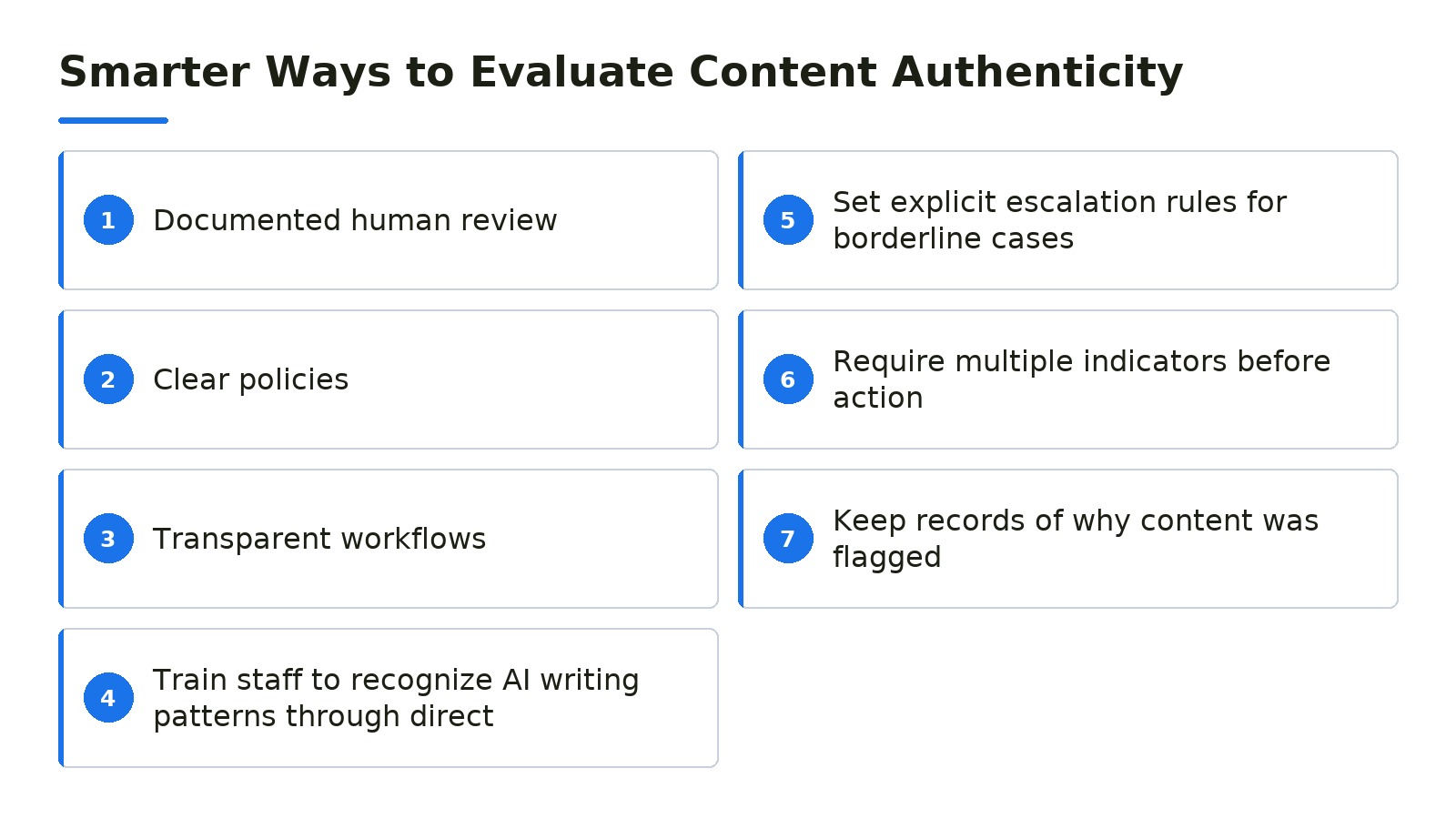
Documented human review, clear policies, and transparent workflows reduce the harm from any single tool’s errors. Train staff to recognize AI writing patterns through direct comparison rather than outsourcing judgment entirely to a score.
Set explicit escalation rules for borderline cases, require multiple indicators before action, and keep records of why content was flagged. These steps help with compliance and demonstrate good faith if decisions are later questioned.
How The SEO IT Guy approaches content verification for MSPs
The SEO IT Guy works exclusively with IT companies and managed services providers to generate leads from organic Google searches and Google Maps in their local markets. Steve Dempsey, the owner, brings over 20 years of IT support experience to SEO strategy, understanding both the technical language IT clients use and the marketing side that converts visitors into leads.
The team offers tailored SEO optimization, website audits, and Zomentum Consulting for MSPs who want to grow without chasing unreliable shortcuts. Every campaign starts with a systematic onboarding process and a customized roadmap, because no two businesses or locations are the same.
Why detector algorithms struggle with technical MSP content
Managed service providers produce highly structured documentation that confuses detection systems. Technical writing follows predictable patterns by design, which algorithms mistake for machine generation.
SOPs, network diagrams, and troubleshooting guides use standardized terminology repeatedly. This repetition triggers statistical signatures that detectors associate with synthetic text.
MSP content often includes exact specifications, compliance requirements, and vendor nomenclature. These constrained vocabularies limit linguistic variation in ways that penalize human authors.
Bullet points and numbered procedures further reduce sentence complexity scores. Detectors interpret this clarity as evidence of artificial origin rather than professional communication standards.
The same content written for CIOs versus end users receives different flag rates. Detector sensitivity shifts unpredictably based on audience sophistication and technical depth.
Industry-specific acronyms and initialisms create unusual character distributions. These patterns diverge from the training corpora detectors use to establish human baselines.
Small MSPs outsourcing technical writing face compounded verification challenges. Their subject matter expertise becomes harder to demonstrate when third-party authors trigger additional scrutiny.

The hidden cost of running detectors on your content workflow
Teams waste hours interpreting inconsistent scores that lack actionable meaning.
Subscription costs for enterprise detector platforms accumulate quickly across multiple seats. These expenses divert budget from actual content creation and strategy development.
The verification step often becomes a bottleneck that delays publication schedules. Marketing calendars slip while stakeholders debate whether a 73 percent human score passes muster.
Staff training on detector interpretation consumes productive capacity better spent elsewhere. Employees learn to game metrics rather than improve genuine communication quality.
Client-facing materials delayed for detector clearance miss time-sensitive opportunities. Competitive announcements and market responses lose impact when held for bureaucratic approval.
The psychological toll of constant surveillance affects writer morale and creativity. Authors self-censor to avoid triggering algorithms, producing blander, less distinctive content.
For resource-constrained MSPs, these cumulative costs represent significant opportunity loss. The investment rarely returns measurable improvements in audience trust or search performance.
How search engines actually treat AI-assisted versus AI-generated content
Google’s public statements emphasize content quality over production method. Their systems evaluate usefulness, originality, and demonstration of experience rather than provenance.
Search quality raters assess whether content satisfies user intent and demonstrates expertise. No rating guideline instructs evaluators to apply detector tools or score thresholds.
Algorithmic updates target low-value mass-produced content regardless of origin. Human-written affiliate spam receives identical demotion to synthetic equivalents when unhelpful.
Helpful content updates specifically penalize material created primarily for search ranking. This intent-based standard applies equally to human and machine authors gaming the system.
Google’s spam policies reference automation without distinguishing assistive from generative use. The critical factor remains whether output serves readers or manipulates rankings.
Documented case studies show AI-assisted content ranking well when edited by subject experts. Conversely, purely human content fails when thin, outdated, or misaligned with search intent.
MSPs should prioritize demonstrable expertise signals over detector compliance. Original research, firsthand implementation experience, and specific client outcomes matter more than authorship verification.
Building a defensible content authenticity process without detectors
Establish clear editorial standards that emphasize factual accuracy and unique perspective. Documented review processes create audit trails more reliable than algorithmic scores.
Require subject matter expert sign-off on technical claims and recommendations. Named accountability beats anonymous detector reports when disputes arise about content legitimacy.
Maintain version histories showing iterative development and refinement stages. Genuine human collaboration produces characteristic revision patterns that synthetic outputs rarely replicate.
Incorporate specific client experiences, anonymized case details, and implementation timelines. These concrete elements resist generation and demonstrate authentic operational knowledge.
Publish author bios with verifiable credentials, certifications, and professional histories. Transparent expertise attribution builds reader trust more effectively than detector clearance.
Engage with community comments, forum discussions, and industry events using consistent voice. Cross-platform presence creates coherence that isolated content pieces cannot fake.
For MSPs serving regulated industries, align documentation practices with compliance frameworks. SOC 2, HIPAA, and CMMC requirements already mandate controls that incidentally verify human oversight.

Frequently Asked Questions
What is a false positive in an AI detector?
A false positive happens when the detector labels human-written text as AI-generated. Research shows these errors occur at high rates for certain writing styles, particularly from non-native English speakers.
Can AI detectors reliably identify chatbot-written content?
Commercially available tools correctly identified AI content roughly 63% of the time in one study, with false positives between 24.5% and 25%. These error rates mean detectors should not be used as sole evidence for important decisions.
Why do non-native English writers get flagged more often?
Detectors train predominantly on native English patterns, so writing with simpler vocabulary or different sentence structures triggers false alarms. One study found approximately 61.3% of non-native English samples were misclassified.
Should small businesses use AI detectors at all?
Detectors can serve as a preliminary screening tool when combined with human review and clear policies. Relying on them as definitive proof creates legal and operational risks that most small businesses are not prepared to manage.
What should I do if a detector flags my own writing?
Request human review, document your writing process, and ask for specific evidence beyond the score. Keep drafts, timestamps, and revision history to demonstrate authenticity if questioned.
How can an MSP prove content authenticity to skeptical prospects?
Document your editorial process with named reviewers, version histories, and specific expertise credentials. Reference verifiable client outcomes and implementation details that demonstrate firsthand experience.
Transparent author attribution and consistent cross-platform presence build credibility that no detector score can replicate.
Sources

About the author
Steve Dempsey - Owner / Founder
Steve Dempsey is the owner and founder of The SEO IT Guy, an SEO agency for managed IT services providers that he started after more than 20 years running his own IT support company.